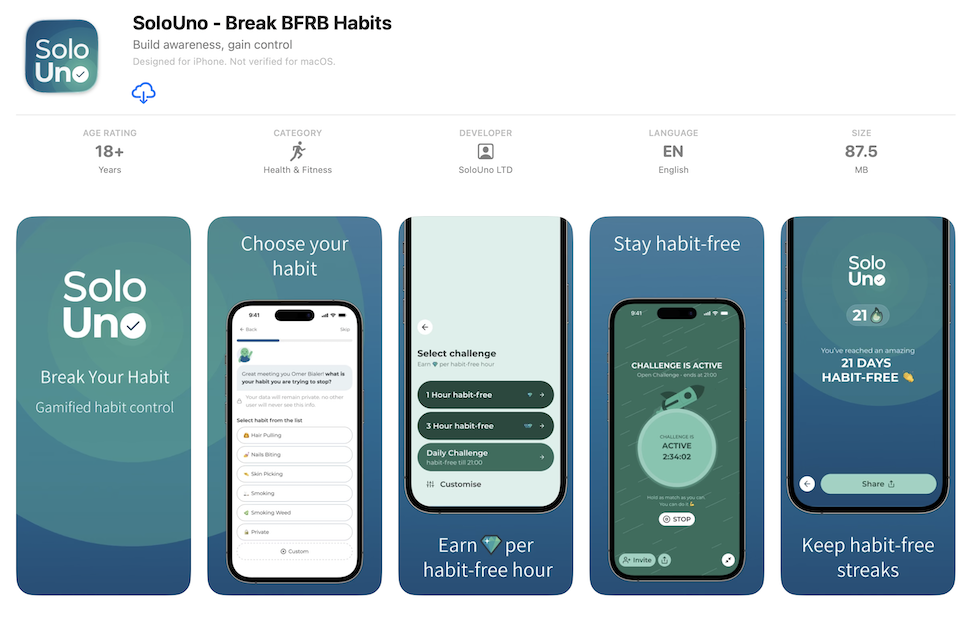
Before you read any further, this app’s description is an attention grabber for sure. Behold:
Hair pulling, skin picking and nail biting.
That’s a definite differentiator.
Okay, here we go.
SoloUno – Break BFRB Habits takes a more focused approach than the typical habit tracker. Designed around body-focused repetitive behaviors (BFRBs) such as hair pulling, skin picking and nail biting, it helps users recognize triggers and gradually resist unwanted habits.
Rather than asking you to quit forever, SoloUno breaks the goal into manageable timed challenges — an hour, three hours or until the evening — and tracks your progress along the way.
It’s a simple approach that seems well suited to the problem.
More Than a Streak Counter?
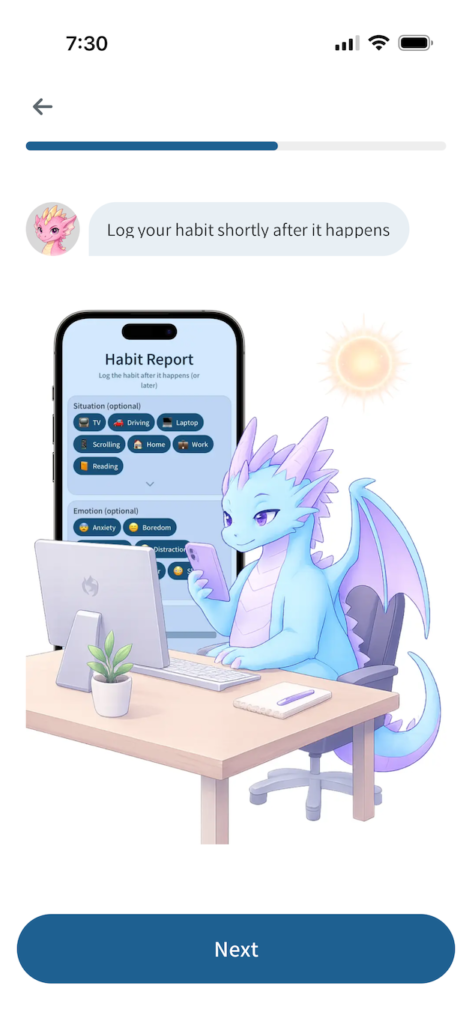
There are countless habit-tracking apps built around maintaining streaks, so I assume. SoloUno breaks it down as follows (paraphrased from their own words):
- Log the habit — Record when it happens and what was going on at the time.
- Figure out your triggers — Look for recurring situations, emotions and circumstances behind the behavior.
- Take timed challenges — Resist the habit for manageable periods and gradually work your way up.
- Deal with the urge — Use an urge-acceptance exercise when temptation strikes.
- Check in daily — Evening check-ins and reminders help keep you on track.
- Grow your companion — Progress is rewarded with a creature that grows and evolves along with you.
So there is some gamification here, but thankfully it doesn’t appear to overwhelm the app’s underlying purpose.
I Put It to Work
Naturally, reviewing a habit-breaking app requires having a habit to break.
SoloUno doesn’t force me to select from a predetermined list of behaviors, so for testing purposes I entered a somewhat less clinical habit of my own — one that rhymes with “hose trickling.”
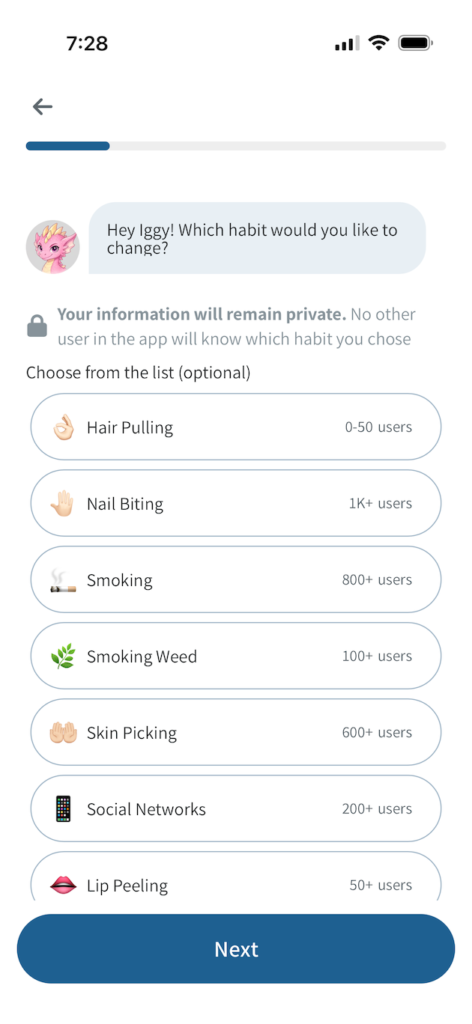
I’ll leave the exact nature of this terrible affliction to the reader’s imagination.
The important part is that SoloUno didn’t judge me. It simply asked me to start tracking it.
And this is actually one of the app’s nicer design decisions. SoloUno doesn’t need to know exactly what you’re trying to stop doing. The mechanics work whether you’re dealing with a recognized BFRB or simply some repetitive behavior you’d rather do less often.
The Clock Is Ticking
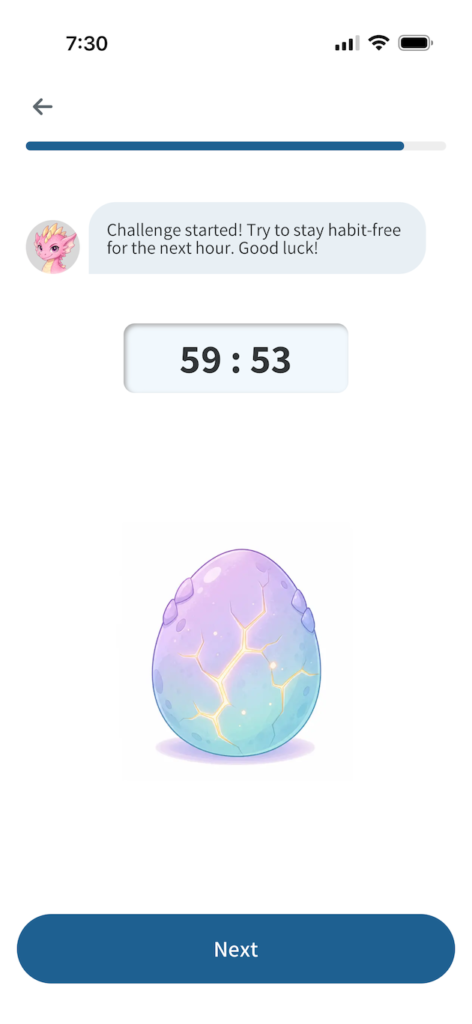
My first challenge was straightforward: don’t do the thing.
For a while.
This is where SoloUno’s approach started making more sense. Instead of confronting me with the depressing proposition that I must never indulge in my completely hypothetical “hose trickling” habit ever again, it gave me a much smaller target.
Make it through the next hour.
An hour? I can do an hour.
Probably.
And when you succeed, you get the modest satisfaction of recording the victory and moving on to a longer challenge. It’s less “CHANGE YOUR LIFE TODAY!” and more “How about we get through lunch first?”
I prefer the latter.
Here Be Dragons
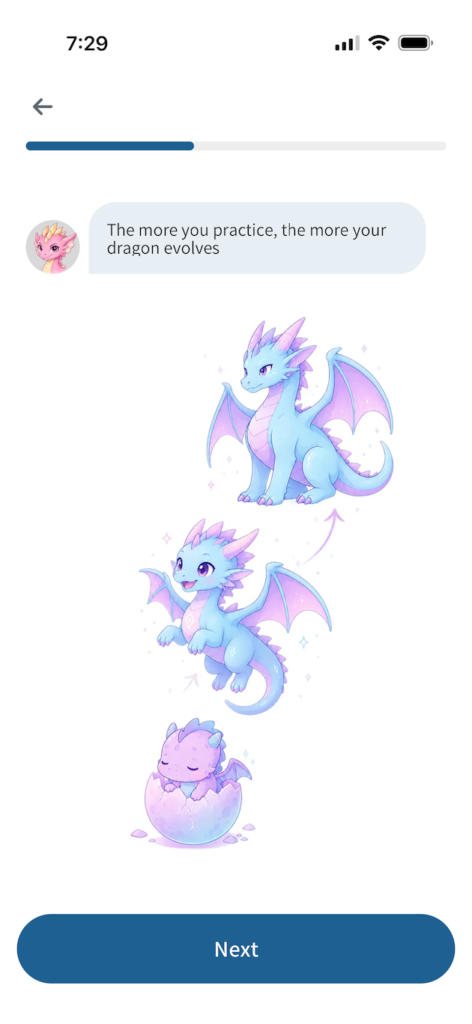
During onboarding, SoloUno informed me that as I meet and beat my timed challenges, my dragon will grow and evolve.
Wait. A little creature that grows and evolves as I progress?
I suddenly experienced a strange flashback involving a certain extraordinarily popular Japanese franchise about collecting pocket-sized creatures.
Which immediately raised another question: why stop at dragons?
The evolving companion is a fun idea, and it seems like an opportunity begging for a creative explosion. Let me choose an egg and discover what hatches. Dragons, griffins, phoenixes, blob monsters, miniature dinosaurs, strange woodland creatures, inexplicable fuzzy things with three eyes — go nuts.
Different creatures could evolve along different paths. Perhaps some are unlocked through accomplishments. Maybe particularly difficult challenges produce rarer creatures. Users could build a little collection over time.
None of this is necessary for SoloUno’s core purpose, of course. But if you’re going to motivate me with a creature that grows as I resist my habit, give me creatures.
I want to see what my hose-trickling abstinence eventually hatches.
Privacy — Read the Fine Print
I didn’t go particularly deep into SoloUno’s privacy practices for this review. If that’s your kinda thing — and given the personal nature of what you may be tracking, it probably should be — do your homework and read the fine print.
Check the App Store privacy information and the developer’s privacy policy before signing up. I’m reviewing the app, not conducting a privacy audit, so I’ll leave that judgment to you.
If privacy matters to you, read before you tap Agree.
The Subscription Question
This is where it hits you again. The crossroads. Is it really worth it? Is it worth even a reduced amount of what they charge?
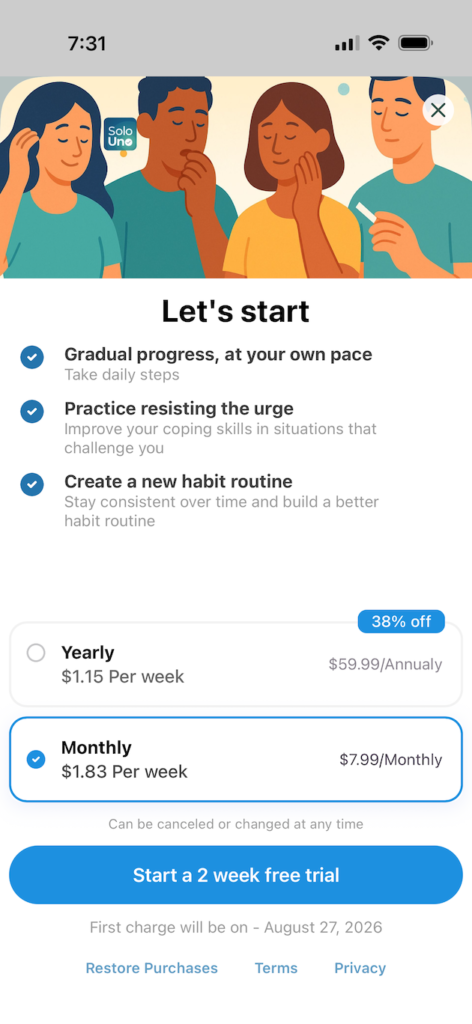
SoloUno gives you two weeks free, then it’s $7.99 a month or $59.99 a year at the standard U.S. App Store price.
If the app genuinely helps you control a difficult habit, that may be money well spent. If you’re looking for a glorified habit tracker, probably not.
That’s what the two-week trial is for. Use it before you decide.
Where SoloUno Could Improve
- Rethink the compensation model. The subscription is the biggest hurdle for me. Maybe an ad-supported free version could work, with a paid option to remove the ads. For an app built around encouraging healthier habits, getting people through the door without immediately facing another subscription would be a plus.
- More creatures. More animations. More weirdness. The dragon is a great start, but the companion idea has much more potential. Give me creatures to unlock, different evolution paths, eggs to hatch and more animations as they grow. If gamification is part of the motivation, lean into it.
- Give me more habits to choose from. Hair pulling, skin picking and nail biting establish the app’s BFRB focus, but I’d like a larger selection of common habits during setup, while still keeping the custom option. That way I don’t have to invent a habit that mysteriously rhymes with “hose kicking.”
- Build a bridge to real-world help. SoloUno could create a network or directory of healthcare professionals who specialize in BFRBs and related behaviors. If tracking shows that you’re struggling with a particular problem, the app could help you find an appropriate professional who deals with it. The app helps you recognize the problem; why not also help you find someone qualified to help with the next step?
What I Like
- You can’t beat that attention-grabbing description. Hair pulling, skin picking and nail biting certainly got my attention. In an App Store full of apps that start sounding alike after a while, SoloUno immediately tells you exactly what it’s about.
- Nice dragon artwork. The dragon gives the app some personality and keeps a potentially serious subject from feeling overly clinical. As mentioned earlier, I’d just like to see a lot more of them.
- I appreciate what they’re trying to do. Helping people address habits they probably want to get rid of — without immediately resorting to expensive sessions on a therapist’s couch — is a worthwhile idea. SoloUno isn’t a substitute for professional help, but I appreciate the attempt to give people an accessible tool they can start using on their own.
Conclusion
Meh.
Obviously, I didn’t have enough time with SoloUno to find out whether it really works. Kicking the “hose kicking” habit takes a while to track — even if, for the record, I don’t actually have a hose-kicking habit.
And I still have questions. Is SoloUno essentially a bunch of cleverly packaged timers underneath? Does the tracking reveal something genuinely useful after weeks of use? Does the dragon actually become part of the motivation?
There’s definitely room for more fun. More creatures, more animations, more rewards and more gamification for us hypothetical hose kickers.
SoloUno has an interesting idea and, dare I say, something of a humanitarian cause behind it: helping people deal with behaviors they genuinely want to change. That’s admirable.
The subscription, however, isn’t helping move the needle any higher for me.
The bottom line is, having the following in your description:
Hair pulling, skin picking and nail biting.
is definitely a differentiator.